Monday, August 20, 2012

Tongue twisting

GREENLAND throws up some tongue-twisting names.

Looking at our destinations on the itinerary the words appear to be a jumble of vowels and consonants so complicated I don’t know where to start in saying them, but once I hear someone announce these places I realise they are not only easy but often very poetic.

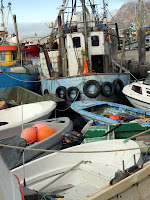
Yesterday it was Kangerlussauq (kanger-loo-sack) and today it’s Sisimuit (si-si-moot) which, boasting around 6000 residents, is one of Greenland’s larger settlements with locals living in the streets stretching back from the busy port.


We arrived early, when the morning fog was still clinging to the cliffs, but the summer sun was strong enough to burn through the cloud and an assortment of colourful houses were soon revealed.

People have been living in Sisimuit for centuries – it’s long been home to a thriving fishing fleet and there was even a cannery here for a few years – but it blossomed when the Danish government decided it was time to bring the residents of the smaller settlements that once dotted the coast into town.

The area was subdivided during the 1970s, with the first simple cabins built to accommodate the newest residents, and now the traditional ways are taking a backseat as the Inuit adapt to living in large communities that are regularly resupplied with everything the people need to survive.


After riding the zodiacs to shore we toured the town with a local guide who told us there was still a bit of unhappiness in the hamlet about the forced resettlement, with some of the older folks yearning for the days when they lived off the land, but the young people had embraced the new life and were moving away from traditional professions to more lucrative occupations.

"Skills like fishing were handed from father to son," our guide Anita explained.

"But the sons have discovered fishing is very hard work, and that there are now easier ways to make money, so they aren’t doing that anymore and they aren’t teaching their sons how to do something that was once so important."


The young local also shared the story behind the colours of the Sisimuit houses.

When the Danish government moved in it colour coded the public structures so locals who couldn’t read would be able to find the buildings they needed when it came to apply for hunting licences, enrol their children in school, and have a tooth pulled.

Next it was time to paint the houses and instead of importing new shades from Denmark, which was an expensive endeavour, the locals got their hands on the government surplus and covered their dwellings in the same vibrant tones.


I can only imagine how bright the settlement looks when the neighbourhoods are covered in a thick layer of snow and ice during the long and months of winter.

 
After the excursion I received a lesson in the complicated place names from cruise culturalist John Houston who explained that most destinations were named after a feature that would help those travelling through the region.

"Europeans name places as a tribute to a sponsor – Prince of Wales Island, Victoria Island, King William Island – so it’s a political thing or a token of possession," he explained. 

"The Inuit organise space differently by making a road map that would help future generations survive, so there are places like 'bears live here island' and 'birds live here beach'."

Sunday, August 19, 2012

Anchor's away


IT'S always a magical moment to see your ship for the first time.

Typically that happens in a big-city port somewhere, with the holiday vessel towering above the cranes and stacked cargo containers, but my first glimpse of the Clipper Adventurer came as we drove down into Kangerlussauq's humble port after doing a quick lap of this Greenlandic settlement.


The ship, with its blue hull and white decks, was anchored in the fjord while a fleet of black zodiacs zipped around ferrying passengers and freight on water so calm it reflected the surrounding mountains as if it were a mirror's image.

The Clipper Adventurer will be my home for the next two weeks as we explore these waters inside the Arctic Circle and we started tonight by heading out of the Sondre Stomfjord which is the second longest in Greenland at 180km.

The captain weighed anchor just before dinner, so his new passengers could enjoy the journey along the fjord while dining, and the sheer granite slopes of the surrounding slopes filled the ship's windows while we ate.

There was time before the sun drained from the day to head onto the deck and snap a few pictures of the sunset, and there was a thin layer of cloud hovering across the peaks in the distance as the sky blushed turning a shade of pink far too subtle for this extreme part of the world.

Saturday, August 18, 2012

So, this is Greenland


I FEEL like I'm a very long way from home.


I'm in Kangerlussauq, a settlement on Greenland's wild south-west coast, and it feels like I'm on the other side of the world.


It took three flights to get to this remote destination – there was the hop from Melbourne to LA, a comfortable trip to Toronto, and a four-hour flight into the Arctic Circle this morning – and some of the maps I've seen during the journey didn't even show this final destination in Greenland.


I'm here to do a 14-day cruise aboard an ice-breaking ship called the Clipper Adventurer and, after seeing a small section of the Greenland coast, we will head west across Davis Strait to Baffin Island in Canada and then through the famed Northwest Passage.


The whole journey – apart from a few short hours this evening – will be done inside the Arctic Circle and we will visit Inuit communities, explore glaciers and fjords, and call on isolated spots that were once home to intrepid explorers and incompetent sailors. 


Our expedition started with a tour of Kangerlussauq this afternoon.


It’s a relatively-young settlement that’s home to just a few hundred people and it was established by the US military six decades ago as a place for military planes flying across the Atlantic Ocean to refuel or find sanctuary during bad weather.


The Yanks built the runway here in 1941, and expanded it during the Cold War when the big reconnaissance and bombing planes regularly hopped across the sea to the Soviet Union, but it was handed back to the locals a few years ago.


Greenland is now part of Denmark –I'm ignoring that fact, and counting this as my 51st country – and now most of the residents either work at the airfield or in the ever-expanding tourist trade.


The Danes are so eager to populate this outpost that the government helps any locals looking to build a home, and residents can construct a comfortable cottage with a couple of bedrooms and place to park the snowmobile for the subsidised price of $AUD7000.


It's summertime in Greenland, just a couple of months since the longest day happened, so there's no snow on the ground and Kangerlussauq looks a bit dishevelled with all the faults and flaws usually hidden by the layer of white on full display.


Our tour of the town included a visit to the dog kennels below the runway, where the hounds that pull the sleds during the cold months are accommodated, and we got to meet a couple of these Greenlandic K9s that are part wolf and part the domestic animals we have in Australia.


We also had a stop at the Kangerlussauq Musuem – it was originally the hotel built by SAS to accommodate crews and passengers that made a stop in Greenland during the hop across the Atlantic – and saw the warehouse where the town's supplies are kept.


Only two cargo ships visit Kangerlussauq during the year, delivering everything this snug settlement needs to survive, with the stores put in the prized warehouse near the airport.


And this is such an isolated spot that there must be at least two years worth of provisions in reserve at any time.

Friday, August 17, 2012

Toronto tourist

I HAD a few hours in Toronto today, as I waited to join my fellow passengers and fly to Greenland to start a voyage on the Clipper Adventurer, so I wandered into town to throw a bit of money into the Canadian economy and see some of the sites.

There wasn't time for any great adventurers so I limited myself to the streets around the Eaton Centre and saw some of the city's magnificent buildings in the early-morning light.


Toronto has a good mix of old and new buildings - sometimes one building will have a collection of old and new features on one site - and when a new building is put up the developer must include a piece of public art on the site.

This can be anything from a sculpture in the lobby or a mural on a wall, but my favourite example was the glass ceiling that's been placed over a working lane not only protecting the thoroughfare from the elements but bringing a palatial belle-epoque attitude into the city.

Thursday, August 16, 2012

Safe in the sky


I DID  a bit of reading for my Qantas flight today.

It was more a matter of good timing than a tactical approach to informed travel, but not long before I stepped onto my Qantas A380 in Melbourne this morning I finished reading QF32 which is the book written by Richard De Crespigny.

He was the very clever pilot that landed the Flying Kangaroo's first double-decker aircraft when an engine exploded over Indonesia a few years back.

I heard lots of stories about the now-infamous incident from the Qantas folk I met doing the trip to Seattle last year so was interested and bought the captain's book when it hit the shelves earlier this month.

Not the best reading for someone about to fly an A380?

True.

But that incident, and reading the book, had the opposite effect upon me and I'm now a loyal Qantas customer hoping that if I'm every in a plane that has a faulty engine there's a team of QF pilots in the pointy end.

Captain De Crespigny and his crew did such a magnificent job that day landing the disabled aircraft when only one of the 21 flight systems was working normally and all four engines were "degraded'' with a complete failure of the fuel system.

I have no doubt, after hearing the inside information from the Qantas team, that if the same thing happened to any number of other airlines it would have ended with the loss of every life on board.

But the experienced Qantas crew kept the damaged aircraft in the air for a couple of hours, then wrestled it onto the ground at Changi Airport and safely evacuated every person on board.

Captain De Crespigny did say one thing in QF32 that I experienced first hand last night.

In one chapter about the revolutionary Airbus vessel he described the "dance of the ailerons'' which keep the plane steady in flight.

There's a collection of flaps on the wing that operate automatically when the aircraft hits a bit of turbulence, flapping and waving to adjust and stop the plane ducking and diving around the sky.

I couldn't see the wings from my seat on the second level, but I did take notice when the seat-belt sign came on somewhere near Hawaii.

The A380 hardly moved, you have to love those ailerons.

Qantas, it's always a pleasure.


Wednesday, August 15, 2012

Trip #11 (2012)

AFTER six days in Australia's Top End I can add some flights and hotels to the 2012 stats...

Flights - Three
Kilometres flown - 6987km
Total kilometres flown in 2012 - 92,937km
Hotels - Four...Holiday Inn (Darwin), Mantra Pandanas (Darwin), Connections camp in Kakadu, Connections camp in Katherine
Total hotels in 2012 - 34
Countries visited - Only Australia
Total countries visited in 2012 - Four, not including Australia
New countries visited - Not a one
Total countries visited - 50